
Tubular Battery — What It Is, How It Works, and How to Look After It

If you have a UPS or a solar system at home in Pakistan, there is a good chance the box keeping your lights on is a tubular battery. It is the most common home backup battery in the country, and this guide explains what it is, how it works, and how to make it last — in plain words, with no jargon.
You do not need any technical background to read this. Every hard word is explained with a simple everyday example.
And one thing up front: this article has no prices in it. Prices change every day, so they live on the price page. This guide is about understanding the battery itself, so you can buy the right one and look after it well.
What Is a Tubular Battery, in Simple Words?
A tubular battery is a lead-acid battery. That means it stores power with lead plates sitting in acid water — the same basic idea as a car battery. The difference is the shape of the plates inside.
In a normal flat-plate battery, the working material is pasted flat onto a grid, like butter spread on bread. Every time the battery charges and discharges, that material swells and shrinks. Over time it flakes off and falls to the bottom of the case. That flaking is the main reason flat-plate batteries die early.
A tubular design fixes this one problem. The working material is packed inside long tubes instead of being spread flat. The tubes hold the material in place while it swells and shrinks, so far less of it flakes away. That is the whole secret — tubes instead of flat plates.
How a Tubular Battery Is Built
Inside the case there are two kinds of plates. The positive plates are the tubular ones. Each one has a lead spine in the middle, like the bone in a fish, with the working material packed around it. The material sits inside a woven tube called a gauntlet, made of polyester or glass fibre, and the gauntlet is the part that stops the material from shedding.
The negative plates are flat sheets of lead. They sit between the tubular plates, with a thin separator keeping them apart. All of this sits in diluted sulfuric acid — the liquid that carries the charge between the plates — inside a thick plastic case, and the top has vent caps that let gas escape while the battery charges. If you want the engineering detail, Microtex explains how tubular plates are made on its own page, in plain engineering terms.
How It Works When the Lights Go Out
Think of the battery like a water tank. Charging fills the tank. Discharging empties it. The tubes do not change this — they only make the tank last longer.
Charging: Putting Power Back In
When you charge the battery, power from the charger — or from your solar plates through the inverter — pushes the chemistry backwards. The used-up material on the plates turns back into fresh lead and lead dioxide. The acid gets stronger again. A full charge from empty takes around 10 to 14 hours, so most homes charge overnight or through the day while the sun is up.
Discharging: Giving Power Back
When the power goes out, your tubular battery gives the stored power back. The lead and lead dioxide react with the acid and turn into lead sulfate. The acid gets weaker as the battery empties. This is normal — the battery is built to do this again and again, and that repeated filling and emptying is called cycling.
How deep you empty it matters. If you only use the top half of the charge, the battery lasts far longer than if you drain it to the bottom every night. The usable part is about 60% of the full charge. Draining past that every day is the fastest way to shorten its life.
Tubular vs Flat Plate — the Honest Difference
Both are lead-acid batteries. Both use the same acid and the same basic chemistry. The only real difference is the shape of the positive plate. But that one difference changes almost everything about how the battery behaves.
A tubular battery holds its active material in tubes, so it survives daily deep cycling. A flat-plate battery is cheaper to make, and it is fine for short backup — a car starting, or a UPS that only runs for a few minutes. For a home that loses power every day, tubular wins. For a car, flat plate wins, because a car needs a short hard burst of power, not slow deep cycling.
| Tubular | Flat plate | |
|---|---|---|
| Lifespan with care | 4 to 8 years | 3 to 5 years |
| Deep discharge | Handles it well | Wears out fast |
| Daily cycling | Built for it | Not built for it |
| Maintenance | Water top-up every few months | Water top-up more often |
| Best for | Home UPS and solar | Cars and short backup |
| Cost over time | Lower — fewer replacements | Lower upfront, higher over time |
The table tells the story in one line: flat plate is cheaper to buy, tubular is cheaper to own. If your power goes out once a month, a flat-plate battery is enough. If it goes out every day, tubular pays for itself by lasting years longer.
Short or Tall — Which Size Fits Your Home?
Walk into any battery shop in Pakistan and you will see two shapes: short tubular and tall tubular. Both are the same technology. The difference is physical — tall ones have longer tubes and hold about 30% more acid per tube than short ones of the same size.
Short Tubular
Short tubular batteries are shorter and wider, so they fit in tight spaces, under a stair or in a small corner. They cost less up front. But they hold less acid, so they give shorter backup and usually last 3 to 5 years. They suit a small UPS that only covers short load-shedding.
Tall Tubular
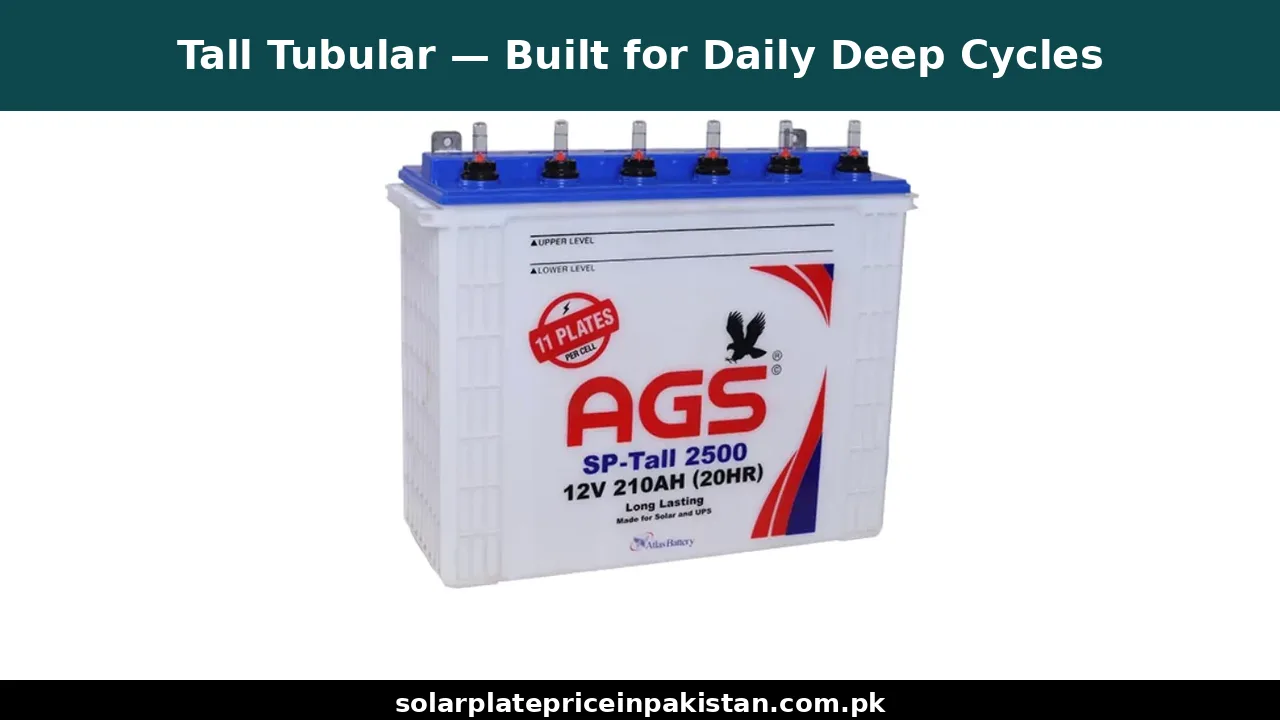
Tall tubular batteries are the ones you see most in Pakistani homes. They are taller, hold more acid, and give 20 to 30% longer backup than a short one of the same amp-hour size. They usually last 5 to 7 years with care. If you have daily load-shedding or a solar system, tall is almost always the better buy.
The size is written as amp-hours, or Ah. Think of Ah like the size of a water tank — a bigger number means more stored power. Common home sizes run from 100Ah to 250Ah. A bigger Ah gives longer backup, but it also takes longer to charge, and the worked-out size for your home depends on your load and your backup hours — the formula is in the questions at the end of this guide.
Where This Battery Makes Sense — and Where It Does Not
Tubular batteries shine in three places: home UPS systems, solar systems, and anywhere the power goes out every day. They are the workhorse of Pakistani homes because they handle daily deep cycling and they can be fixed by any battery shop in the country.
They also suit farms and small shops. A tube-well pump or a shop that needs lights and fans through load-shedding is exactly the job tubular was built for. And in areas with no grid power at all, a tubular bank paired with solar plates keeps the basics running.
They do not make sense everywhere. They are heavy — a big one can weigh as much as a grown person — and they need water top-ups and a ventilated room. If you want zero maintenance, a tiny size, or the longest possible life, lithium is the better choice. But lithium costs far more up front, and that is why most Pakistani homes still pick tubular.
Tubular vs Lithium
Lithium lasts 10 to 15 years, needs no water, and gives you almost all of its stored power. Tubular lasts 4 to 8 years, needs water top-ups, and gives you about 60% of its stored power. Lithium wins on every point except one: the upfront cost, so if you cannot afford lithium today, tubular is the sensible buy — and you can switch to lithium later. For the lithium side of the comparison, see the lithium battery prices page.
One hard rule: never mix the two on one inverter. They charge differently, and mixing them damages both. The same goes for mixing an old battery with a new one in the same bank.
How Long Does It Last?
A well-kept tubular battery lasts about 4 to 8 years in a Pakistani home. The exact number depends on three things: how deep you discharge it, how hot it gets, and how well you look after it.
Cycles are the best way to think about it — one cycle is one full charge and discharge. These batteries are built for roughly 1,200 to 1,800 deep cycles. If you cycle one once a day, that is 3 to 5 years of daily use. Lighter use — only the top half of the charge — stretches that further.
Heat is the silent killer of a tubular battery. Lead-acid life halves for every 8 to 10 degrees above 25°C. A battery in a hot Lahore rooftop room in June, at 45°C or more, can lose years of life. Keep it in the coolest ventilated corner you have, out of direct sun.
Warranty tells you something too. In Pakistan, tubular batteries usually carry 1 to 2 years of warranty. That is shorter than the battery’s real life — the warranty is the maker’s promise, not the limit. A battery that dies in year one was probably a bad piece or badly kept, not a worn-out one.
How to Look After Your Battery
Looking after this battery is simple, but it has to be regular. Four small jobs, done on time, can add years to its life.
- Top up the water every 2 to 3 months — distilled water only, never tap water. In summer, check every month. The water level should sit between the two lines marked on the case.
- Keep the terminals clean. Once a month, wipe the tops and the terminals. White or green crust on the terminals means corrosion — clean it off and smear a little petroleum jelly on the terminals.
- Do not overcharge, and do not drain it flat. A good inverter with the right settings does this for you. If your inverter lets you set the cut-off, 10.5 volts is the usual floor.
- Give it air. Batteries release a little hydrogen gas while charging. Keep the room ventilated and never put a flame or a lit cigarette near the battery.
That is the whole routine. Water, clean terminals, sensible charging, fresh air. Do these four and the battery will do its job for years.
Mistakes That Kill It Early
Most tubular batteries do not die of old age. They die of mistakes. Here are the ones we see most.
- Tap water in the cells. Tap water has salts in it. Those salts coat the plates and kill capacity. Only distilled or de-ionised water goes in.
- Running it flat every night. Draining below half every day can cut the cycle life from 1,500 down to 400 or 500. If the backup is not enough, add another battery instead of draining one.
- A charger set wrong. Too high a voltage boils the water away. Too low a voltage leaves the battery half-charged, and half-charged plates grow hard sulfate that never comes off.
- No ventilation. Hydrogen gas builds up in a closed room. It has no smell, and it can catch fire. A small vent or an open window is enough.
- Mixing old and new. Putting a new battery next to a 3-year-old one makes the new one age fast. Replace the whole bank together.
If your battery is dying in year two, one of these is usually the reason — not bad luck. Fix the habit and the next battery will last far longer.
Is It Safe to Keep at Home?
Yes, with two rules: ventilation, and keep acid off your skin. If acid splashes on you, wash it off with plenty of water at once. Keep children away from the battery, and never smoke near it. A battery that is looked after is a safe battery.
How to Tell If Your Battery Is Dying
A dying battery gives warnings before it stops completely. The most common one is short backup — the same load that ran for 3 hours now runs for 1. If the backup keeps shrinking, the battery is losing capacity.
Look at the water level and the case. If one cell keeps needing water far more than the others, that cell is working harder than the rest. A swollen or cracked case means the battery has overheated, and it should not be used again.
Smell matters too. A strong rotten-egg smell near the battery means it is overcharging and releasing too much gas. Turn the charger off, ventilate the room, and get the battery checked by a shop before you use it again.
A simple test: charge the battery fully, then run a known load — say two fans — and time how long it lasts. Compare that time with what the same load gave a year ago. If the time has halved, the battery is near the end of its life, and it is time to plan a replacement.
Do not wait for the battery to die completely. A battery that fails in the middle of a hot night leaves you with no backup at all. Start saving for the replacement when the backup first starts shrinking — that way you replace it on your own terms, not in an emergency.
The Brands You Will See in Pakistan
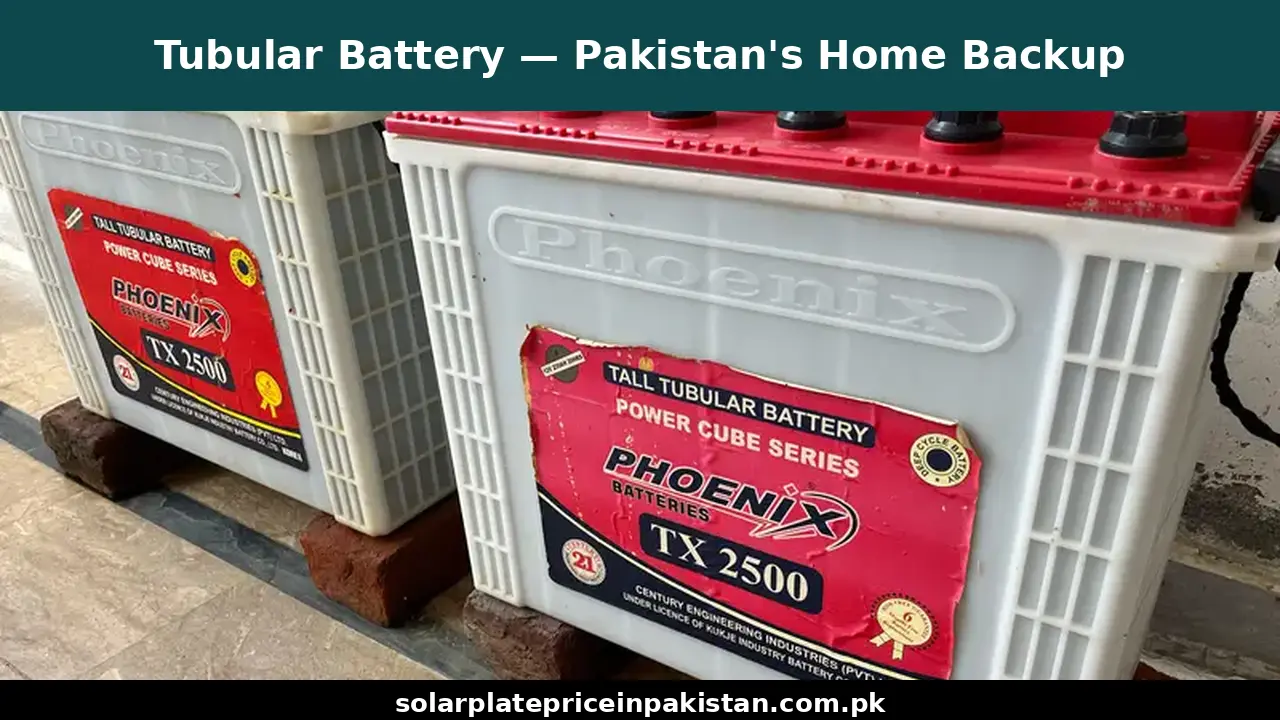
Four names cover almost every tubular sold in Pakistan: Phoenix, AGS, Osaka and Hawk. Phoenix makes the TX series, including the TX 2500 — the tall tubular you will see in most shops — and AGS makes the SP-Tall series, including the SP 2500. Osaka makes the TA and HT series. Hawk makes the HT series for budget buyers.
All four are made in Pakistan, and all four are sold and serviced everywhere. The differences between them are small — warranty length, dealer network, and the exact sizes they offer. What matters more than the badge is the size, the manufacturing date, and the dealer you buy from.
For today’s figures, see the tubular battery price in Pakistan page — it lists every size from all four brands, updated daily.

It is a simple, honest piece of kit. Tubes instead of flat plates, water top-ups instead of a computer, and years of backup for a price most homes can afford. Understand it, look after it, and it will look after your home. And when the day comes to replace it, the same rules apply: tall over short for daily use, the right size for your load, and a dealer you trust.
If you want to compare it with the other options, the solar inverter prices page and the homepage at Solar Plate Pakistan will point you to the right place.
Frequently Asked Questions
How long does a tubular battery last?
About 4 to 8 years in a Pakistani home with care. Daily deep cycling gives roughly 1,200 to 1,800 cycles. Heat is the biggest enemy — a battery kept in a hot room in June will die years earlier than one kept in a cool, ventilated corner.
Do tubular batteries need water top-ups?
Yes. Check the water every 2 to 3 months, and every month in summer. Top up with distilled water only, up to the line marked on the case. Never use tap water — its salts coat the plates and kill capacity.
Can I use tap water in my battery?
No. Tap water carries salts and minerals. Those coat the plates and cut the battery’s life short. Use distilled or de-ionised water only — it costs very little and it is sold at every battery shop.
What is the difference between tall and short tubular?
Tall ones have longer tubes and hold about 30% more acid per tube than short ones of the same size. That gives 20 to 30% longer backup and usually 5 to 7 years of life, against 3 to 5 years for short. Tall suits daily load-shedding and solar; short suits a small UPS for short outages.
Is tubular good for solar?
Yes, for most homes. It handles daily deep cycling well, it is sold and serviced everywhere in Pakistan, and it costs far less up front than lithium. It needs water top-ups and it gives about 60% of its stored power as usable backup. For a tight budget, it is the sensible pick.
Tubular or lithium — which should I buy?
Lithium if you can afford it and want 10 to 15 years with no maintenance. Tubular if the upfront cost matters, if you plan to upgrade within a few years, or if you need cheap backup for a rental home. Never mix the two on one inverter.
How do I know my battery is genuine?
Check the date code stamped into the top cover, and never buy a battery older than 3 months. Look at the terminals — they should be smooth and silvery-grey, with no dents or acid marks. Match the serial on the case with the serial on the warranty card, and always take a computerized invoice with the dealer’s stamp.
Can I mix an old battery with a new one?
No. The old one drags the new one down, and the new one ages fast. Replacing two of four cells when one dies can cut the new cells’ life by about half. Replace the whole bank together.
Why does my battery die so fast in summer?
Heat. Every 8 to 10 degrees above 25°C halves lead-acid life. A battery sitting in a 45°C room in June is ageing twice as fast as one at 25°C. Keep it in the coolest ventilated corner you have, out of direct sun, and check the water every month in summer.
How many batteries does my home need?
It depends on your load and your backup hours. Use this formula: (total watts × backup hours) ÷ battery voltage ÷ 0.8. For example, 380 watts × 5 hours ÷ 12 volts ÷ 0.8 = about 198 amp-hours, so a 200Ah battery. Or work it out with the solar load calculator on this site.