
585 Watt Solar Plate Price in Pakistan

585 Watt Solar Plate Price in Pakistan — 23 November 2026
DeepBlue 4.0 N-Type TOPCon Bifacial 585W
- ✓ DeepBlue 4.0 N-Type
- ✓ Bifacial
- ✓ Tier-1 brand
TOPHiKu6 N-Type TOPCon Bifacial 585W
- ✓ TOPHiKu6 N-Type
- ✓ Bifacial
- ✓ Tier-1 brand
Compare on the per-watt rate, not on the plate price alone. The per-plate price is the wattage multiplied by the per-watt rate. The cards above are filled only from verified solarrate.pk dealer listings, using the listing closest to each brand’s typical per-watt rate, and there are three cards, not six. Longi, Trina and Inverex have no verified 585W listings on solarrate.pk, so they are not shown rather than filled with a guess: Longi’s flagship is the 645W Hi-MO X10, Trina’s is the 625W Vertex N, and Inverex’s is the 620W Mustang — all covered on their brand pages. The three plates above are the ones with verified listings today, and their figures match the brand pages and the city pages exactly.
If you search for 585 watt solar panel price in pakistan, or simply solar 585 watt price in pakistan, you will find the same plates listed here — in Pakistan, a 585 watt solar panel and a 585 watt solar plate are the same product.
Price guides and dealer listings do not always agree. Solar Citizen (updated 2 November 2026) and Checkprice.pk (10 November 2026) list higher rates than solarrate’s dealer listings, and the price guides’ brand rates run higher than the dealer listings too. Solar Citizen sits in between, and Technokraft is closest to solarrate. The cards above use the dealer listings, because those are the prices a buyer can actually pay. See today’s prices in the cards above. For every wattage of each brand, see the brand pages: Jinko | Longi | Canadian Solar | Trina | JA Solar | Inverex. For the 580W class, see the 580 watt solar plate price in Pakistan page, and for the next size up, the 600 watt solar plate price in Pakistan page.
The 585W plate is the size most homes in Pakistan buy — “the most sold size in Pakistan right now”, the residential standard module, the top-selling plate on every dealer’s board. This page lists the 585 watt solar plate price in pakistan for the brands on this site, with the same day’s rates in one place. The rates below match the solar plate price in Pakistan homepage for the same models on the same day. Below the price cards you will find why 585W became the headline wattage, what it compares with 580W, 600W and 700W, how many 585W plates a home needs, what a system costs by size, and how to check a 585W plate is genuine.
The most sold size
585W is the residential standard in Pakistan — the plate on most home quotes, in every dealer’s stock.
9 plates make a 5 kW system
A 5 kW system needs 9 plates of 585W — 5.27 kW of plates on the roof.
Updated daily
Every price below comes from that day’s verified dealer listings — never guessed.

585W or 580W — Which One Should You Buy?
No — and that is the most useful thing to know about 585W. A 585W plate and a 580W plate from the same brand are the same physical size, the same series, the same warranty and the same cell technology. The 585W is the same plate, but one that tested a little stronger. The price difference is small. So buy on the price per watt, the warranty and the dealer’s authenticity — not on the five watts. See today’s prices in the cards above, and compare the rate per watt, not the plate price. The reason 585W is the headline figure and 580W is thinly listed is not that 585W is better — it is that dealers advertise the headline wattage and keep 580W stock for buyers who ask. One warning: because 585W is the highest-volume residential class, it is also the most commonly faked — a “585W Tier-1” plate far below the market rate is not a bargain, it is a B-grade or relabelled plate. The steps at the bottom of this page show how to check.
Why One 585W Plate Costs More Than Another
Five things move the price of the same 585W plate, and none of them is the plate itself:
- Grade — A-grade, B-grade and relabelled stock: A-grade plates are the manufacturer’s first-quality stock with full warranty papers. B-grade plates are factory seconds — lower output, shorter warranty, cheaper per watt. Relabelled stock is the trap: a lower-grade plate sold under a Tier-1 brand name. The gap between A-grade and B-grade is the largest single reason two quotes for “the same plate” differ so much. See today’s prices in the cards above.
- Pallet vs loose: a pallet of 31–36 plates costs less per watt than a single plate. A loose plate bought at retail carries the shop’s margin, the handling and the delivery.
- The dollar rate: plates are imported, so the rupee-dollar rate moves the plate price week to week. A quote from last week is not today’s price.
- Season: demand peaks in the summer, when load-shedding and high bills push buyers to install. Prices are usually softer in the winter months — November to February is the best buying window.
- Freight and dealer margin: every plate carries freight from Karachi Port on top of its import price — and a showroom charges more than a wholesale dealer, because its rent and its service are different. The plate is the same; the distance and the service around it are not. Plates cost less in Karachi, near the port, and more in cities further away. See today’s prices in the cards above.
Because of all five, the honest way to read a 585W price is as a band, not a single figure — see today’s prices in the cards above. And always ask whether the price includes the sales tax (GST): there is no customs duty on imported plates, and the sales tax is 10% since July 2025, so a quote that leaves the tax out will look cheaper by exactly that much, and the tax is still payable.
How to Work Out the Right Number of 585W Plates
That depends on your load, not on the plate alone. Your load is all the electricity your home uses — fans, lights, fridge, air conditioner and everything else. Work out your load first with our solar load calculator, then divide the system size you need by 585. The sizing maths is simple: the system size you need in kilowatts equals your daily use in kilowatt-hours divided by the peak sun hours, times a derating of 0.80 for real-world losses. Peak sun hours are the hours of strong sun in a day. Derating is the power lost to heat, dust and wires — about 20%, so you keep 80% of the power (0.80). Pakistan averages about 5.5 peak sun hours a day, though solarrate’s 585W page uses a more careful 4.5 — use the careful figure when you size, so the system does not disappoint you in winter. As an example, one 585W plate makes about 2.6 units a day, so a home that uses 20 units a day needs about 8 plates. Round that up to 9 plates, which is 5.27 kW of plates — a little extra for winter, which matches the plate counts below.
How Many Plates and How Much Roof Space Each System Size Needs
One 585W plate makes about 2.6 units of power a day, when it gets 4.5 hours of strong sun a day. That is about 79 units a month. The plate counts below are for 585W plates, from Solar Citizen’s sizing guide, and they include the usual oversizing — a “5 kW” system is 9 plates, which is 5.27 kW of plates, because inverters and wiring lose some of the power on the way to your home. A 1.5-ton inverter air conditioner needs 3–4 × 585W plates on its own.
| System size | 585W plates needed | Plate capacity (DC) | Roof area needed |
|---|---|---|---|
| 3 kW | 6 plates | 3.51 kW | ~16 m² |
| 5 kW | 9 plates | 5.27 kW | ~23 m² (350–450 sq ft) |
| 6 kW | 11 plates | 6.44 kW | ~29 m² |
| 10 kW | 18 plates | 10.53 kW | ~47 m² |
| 15 kW | 26 plates | 15.21 kW | ~68 m² |
| 20 kW | 35 plates | 20.48 kW | ~91 m² |
If you want 10 plates instead of 9 for a 5 kW system, that is 5.85 kW of plates — a common oversizing choice, because it covers the winter dip and the inverter’s losses. For full system rates, see our solar system price in Pakistan page.
585W, 600W or 700W — Which Size Suits Your Roof?
The 585W plate is the sweet spot for most Pakistani residential roofs: the best rupees per watt, widely available, and it fits most inverters. Longi’s 645W plate costs more per watt and makes sense only when roof space is genuinely tight. Jinko’s 720W plate needs fewer plates for a large array, but its size and its weight of about 35 kg or more make single-person installation and tight-roof routing harder. The 585W plate wins on handling ease — about 27 kg, light enough for one installer to carry up a ladder — on installer familiarity, on broader stock availability, and because 9 plates make a 5 kW system and 18 plates make a 10 kW system, which fits common inverter sizes. For most homes, the right question is not “which wattage is best?” but “which wattage gives me the lowest price per watt from a dealer I trust?” — and in November 2026, that is usually 585W. Compare the next size up on the 600 watt solar plate price in Pakistan page.
What a Full Solar System with 585W Plates Costs
Plates are only one part of a system’s cost. A complete system also needs an inverter, mounting structure, batteries (for hybrid systems), wiring and installation. For the full system cost by size, see our solar system price in Pakistan page. Always compare quotes with the same items listed: one quote includes the structure and the net metering work, another does not. Net metering is the arrangement with the power company that lets you send spare units back to the grid for credit. Plates are roughly 45–55% of a system’s installed cost, the inverter about 30%, the structure about 14%, cables and protection about 10%, and labour about 8%.
A hybrid system costs more than an on-grid system of the same size, because of the battery and the hybrid inverter. Work out your own size first with the solar load calculator, then use the price cards at the top of this page to price the plates for that size. For inverter rates, see our solar inverter price in Pakistan page, and for battery rates, see our lithium battery price in Pakistan page.
Which 585W Plate Technology Works Best in Pakistan’s Heat?
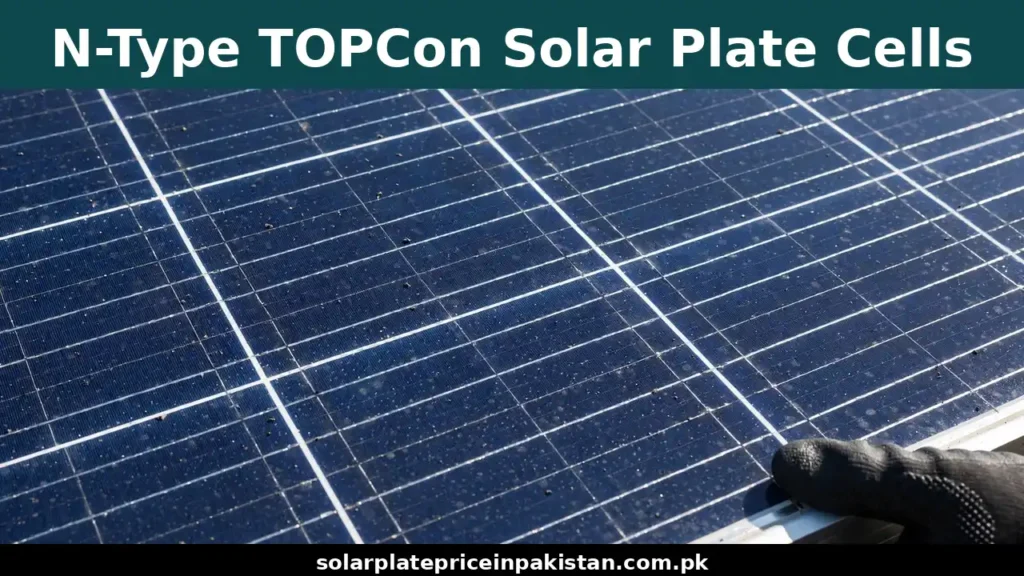
The plates that do best in Pakistan are the ones that lose the least power when they get hot, and that work best when the sun is weak. Two things tell you this. One is the temperature coefficient, which is how much power a plate loses for each degree it heats up. The other is how well the plate works in weak light. The best plates today use a newer type of cell called N-type TOPCon. Next come HJT plates, and last come the older P-type PERC plates. Here is how they compare. N-type TOPCon plates turn 22 to 23% of the sunlight into power, and lose about 0.4% of their power each year. They are the current standard. HJT plates turn 23 to 24% of sunlight into power, and lose about 0.35% a year. They are the premium choice, which means the most expensive and best. Older mono-PERC plates turn 20 to 21% of sunlight into power, and lose about 0.55% a year. They are the last generation, which means the older type. Plates that also catch light from the back, called bifacial plates, add 5 to 15% more power from the back, when they are fixed high enough above a light-coloured roof. Back-contact plates (Longi’s HPBC X10, Aiko’s ABC) give the most watts per square metre, at a higher price per plate. Tier-1 brands, the top brands, give a 12-year product warranty and a 25-year promise that the plate will still make power, down to 80% of its power in year 25. Tier-2 brands, such as EGing, Yingli, ZNShine and Talesun, are 15 to 25% cheaper, but give only a 10-year product warranty. On a hot Pakistani roof, the temperature coefficient is the number that matters most. Jinko’s Tiger Neo is reported at minus 0.29% for each degree Celsius, Longi’s Hi-MO X10 at minus 0.26%, Canadian Solar’s HJT HiHero+ at minus 0.24%, JA Solar’s DeepBlue 4.0 at minus 0.30%, and Trina’s Vertex N at minus 0.29 to minus 0.34%. A plate at minus 0.24% loses clearly less power on a 45-degree afternoon than a plate at minus 0.34%. The 585W models on the market are Jinko’s Tiger Neo 585W (N-Type TOPCon, bifacial, 144 half-cut cells, about 22.6% efficient, about 27 kg, 12-year product warranty, 30-year power warranty), Canadian’s TOPHiKu6 585W (N-Type TOPCon, about 22.3 to 22.6% efficient, about 27 to 29 kg), Astronergy’s 585W (N-type, bifacial, 144 cells, 22.0 to 22.5% efficient, about 30 to 32 kg), JA’s DeepBlue 4.0 585W (N-Type TOPCon), Trina’s Vertex N 585W, Longi’s Hi-MO 7 585W and Inverex’s Mustang 585W.
How to Tell a Real 585W Plate from a Fake One
1. Check the Two Serial Numbers Match
Every genuine Tier-1 plate carries a serial number printed on the back label, with a matching serial sealed under the front glass. Check that both serials match each other and the model and wattage on the label — and check a few plates from each batch, not just one.
2. Use the Brand’s Own Website to Check Your Plate
Confirm the plate on the brand’s own website or app — Jinko at cs.jinkosolar.com (Jinko QR app), Longi at longi.com (Longi Barcode App), Canadian Solar at canadiansolar.com, Trina at trinasolar.com, JA Solar at jasolar.eu, Inverex at inverexsolar.pk — and do not use a QR code or a link the shop gives you instead. Use only the brand’s official website for this check; lookalike “verification” sites are not the brand. A glass-embedded QR code is genuine; a paper or plastic sticker QR code is fake.
3. Ask the Dealer for the Papers That Match Your Plate
Ask for the serial details, the flash test report, the packing list and the invoice trail that match the plate itself, and check that the wattage, the Vmp and the model code on the papers match the plate you are buying. Vmp is the voltage at which the plate gives its best power. A dealer who cannot produce the papers is a dealer to walk away from. Also check the hardware: a junction box sealed to IP68, which means fully sealed against dust and water; stamped MC4 connectors, the standard plugs that join the plates together; and straight, clean busbar lines, the thin metal lines on the plate. These are the marks of a genuine Tier-1 plate.
4. Buy from a Shop You Can Go Back To
A genuine plate from a dealer with a shop you can visit is worth more than a slightly cheaper plate from a seller you cannot find again. Be extra careful with a 585W plate priced far below the market rate — a “Tier-1 585W” plate far below the market rate is not a bargain, it is a B-grade or relabelled plate. The buying guides in the blog explain what else to check.

Choosing an Inverter and Battery for Your 585W Plates
The plate is only half the system. For a 585W array, the inverter decides how much of the plate’s power you actually use. An on-grid inverter suits homes with stable power supply and daytime use. A hybrid inverter suits homes that need backup during load-shedding. An off-grid inverter suits homes with no grid at all. A 585W array is usually 9 plates for 5 kW, or 18 plates for 10 kW, so the rows of plates are short. A row of plates wired together in one line is called a string, and 8 to 12 plates per string is typical. The string maths is part of why 585W became the standard: most 585W plates give about 52 volts when nothing is connected, which is called the open-circuit voltage, so a string of 10 plates sits close to 520 volts, comfortably under the 550 to 600 volt ceiling on most hybrid inverters. The ceiling is set by the MPPT, the part of the inverter that finds the best voltage to take the most power from the plates. But check your inverter’s maximum input voltage before wiring 10 or more plates in one line, especially in winter, when cold weather pushes the voltage above the standard test figure. Keep the rows matched in count and direction. A bifacial plate needs 10 to 15 cm of space behind it, or the extra power from the back is lost. For batteries, dealers stock lithium first, then tubular and Osaka, AGS and Phoenix lead-acid — lithium costs more up front and lasts longer, tubular is the budget backup. Compare inverter rates on our solar inverter price in Pakistan page and battery rates on our lithium battery price in Pakistan page before you choose. Under net billing — the arrangement that lets you send spare units back to the power company for credit — a hybrid system with batteries, which stores the daytime units for the evening instead of sending them back cheap, pays back faster than an on-grid system of the same size: the units you use yourself save you the full price of power from the grid, while the units you send back are credited at a much lower rate.
What Tax Do You Pay on a 585W Solar Plate?
There is no customs duty on solar plates in Pakistan — 0%. Customs duty is the tax charged on things brought into the country. The sales tax on imported plates is 10% since July 2025. The 18% rise that was reported in early 2026 was dropped from the Finance Bill 2026-27, so the 10% figure is the one to use. Inverters carry 5–10% duty, batteries 10–15%, structure 10–15%, and cables up to 20%. Ask your dealer whether the quoted plate price includes the 10% sales tax — a quote that leaves it out will look cheaper by exactly that much, and the tax is still payable.
About This Page
Solar Plate Pakistan is an independent price-information website. We are not an authorized dealer or official partner of any brand. Prices on this page come from dealer listings collected each morning, and the same model’s price is matched across this page, the homepage and the brand pages on the same day. The 585W class is the headline wattage because it is the most sold size in Pakistan — if the cards above show three brands instead of six, that is the honest picture of the day’s verified listings, not a mistake. Questions about this page can be sent through the Contact Us page, or by email at sohaibkhan127222@gmail.com. More about the site on our About Us page and our Our Team page. The rules that govern this page are set by the National Electric Power Regulatory Authority (NEPRA), under the Prosumer Regulations 2026 (S.R.O. 251(I)/2026).
Frequently Asked Questions
What is the 585 watt solar plate price in Pakistan today?
See the cards at the top of this page. They are updated every morning from dealer listings. See today’s prices in the cards above.
Is a 585W plate the same as a 580W plate?
Almost. Same size, same series, same warranty and same cell technology — the 585W is the same plate, but one that tested a little stronger. Buy on the price per watt, not on the five watts.
Why do the price cards show only three brands?
Because only Jinko, Canadian and JA had verified 585W listings on solarrate.pk in today’s re-check (11 November 2026). Longi’s flagship is the 645W Hi-MO X10, Trina’s is the 625W Vertex N and Inverex’s is the 620W Mustang — all covered on their brand pages. Brands with no verified listing are not shown, never guessed.
How many 585W plates do I need for a 5kW system?
9 plates (5.27 kW of plates). A 10 kW system needs 18 plates, a 3 kW system needs 6 plates. A 1.5-ton inverter air conditioner needs 3–4 plates on its own. Work out your own size first with the solar load calculator.
Is 585W better than 600W or 645W?
For most homes, yes on price per watt and handling: 585W is the residential sweet spot at about 27 kg a plate. A 645W plate costs more per watt and makes sense only when roof space is genuinely tight.
Which 585W brand is best?
Jinko is the cheapest of the three verified 585W plates, then JA, then Canadian Solar — see today’s prices in the cards above. Trina and Longi have no verified 585W listing; their closest plates are the Trina 625W Vertex N and the Longi 645W Hi-MO X10. The “best” plate is the one with the lowest price per watt from a dealer you trust, with genuine warranty papers.
Does the 585W price include GST?
Ask your dealer. There is no customs duty on plates, and the sales tax is 10% since July 2025. A quote that excludes GST looks cheaper by exactly that much.
How do I check a 585W plate is genuine?
Match the serial sealed under the front glass with the serial on the back label, confirm the plate on the brand’s own website or app, and ask for the serial details, flash report and warranty papers that match the plate.
Does the 585W price include installation?
No. The cards on this page are plate-only unless a row says otherwise. Inverter, structure, wiring and installation are separate — see the system price page.
Are these prices a final quote?
No. They are indicative rates from dealer listings. Always confirm the final quote with your dealer before paying. See our Disclaimer.