

Crown Inverter Price in Pakistan

Crown Inverter Price in Pakistan — 11 November 2026
Yorker 2kW
Hybrid · IP21 · Pure sine wave
Rs 48,000
Rs 24,000/kW

- 2 kW hybrid
- IP21 indoor only
- Pure sine wave
- 12V battery
- Small-home backup
Yorker 3.6kW
Hybrid · IP21
Rs 83,999
Rs 23,333/kW
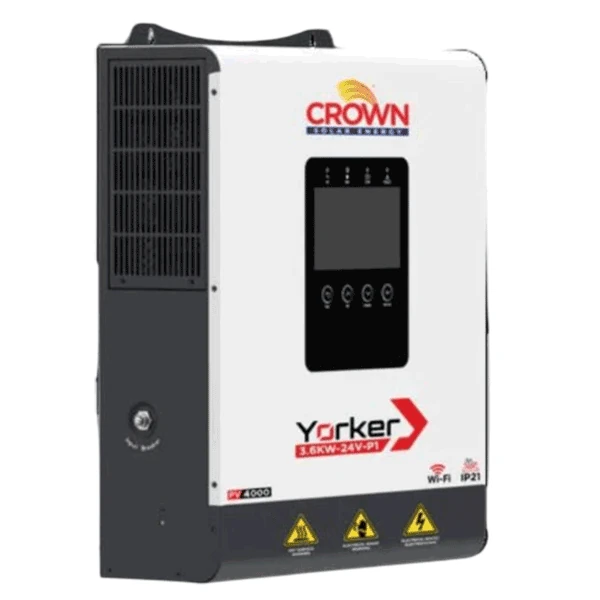
- 3.6 kW hybrid
- IP21 indoor only
- Pure sine wave
- Dual output
- Apartment backup
Yorker Pro 5kW
Hybrid · 48V · Dual output
Rs 99,000
Rs 19,800/kW

- 5 kW hybrid
- 48V battery system
- Dual output circuits
- Pure sine wave
- One-AC home backup
Arceus 5.8kW
Hybrid · IP21 · 4-year tag
Rs 105,000
Rs 18,103/kW
★ Best Value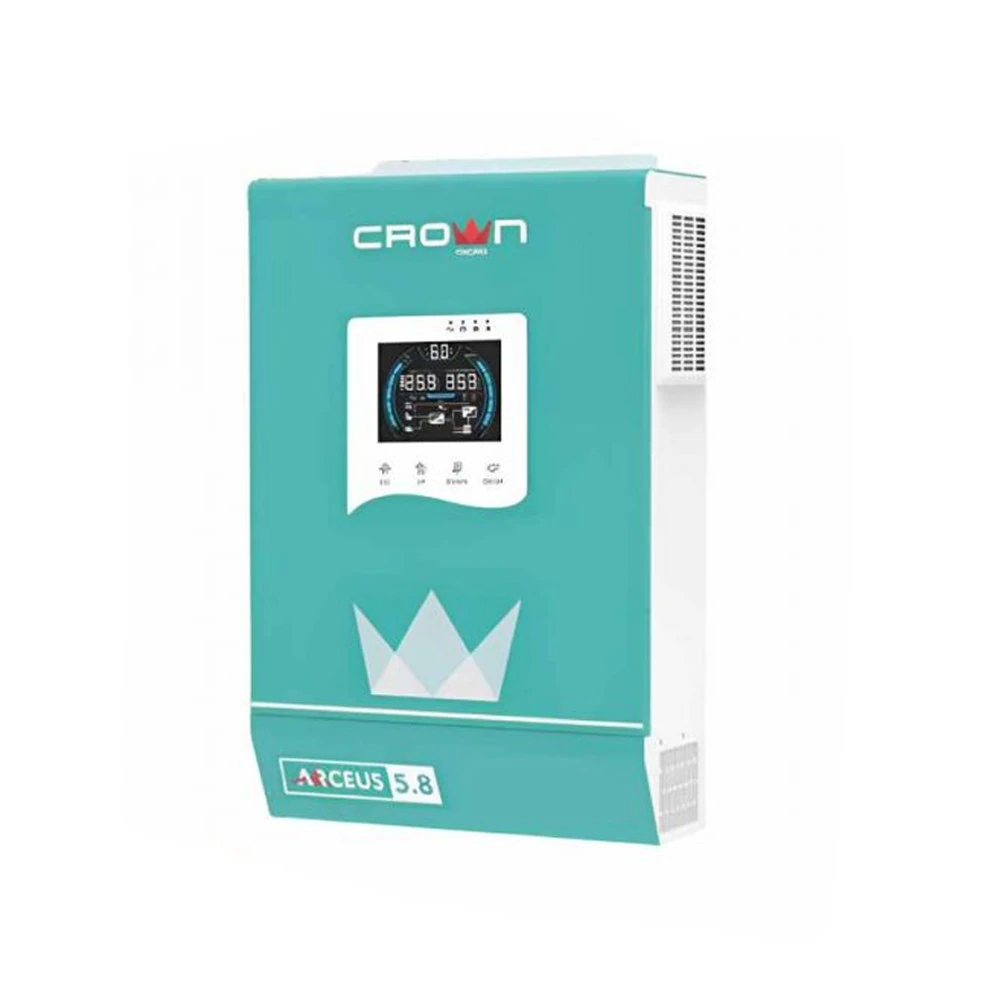
- 5.8 kW hybrid
- IP21 indoor only
- 4-year listing tag
- Middle-ground size
- Best value per kilowatt
Xavier 6kW
Hybrid · IP21 · 5-year tag
Rs 120,000
Rs 20,000/kW

- 6 kW hybrid
- IP21 indoor only
- 5-year listing tag
- Dual MPPT
- 120A MPPT
Elego 6kW
Hybrid · IP21 · 4-year tag
Rs 141,000
Rs 23,500/kW
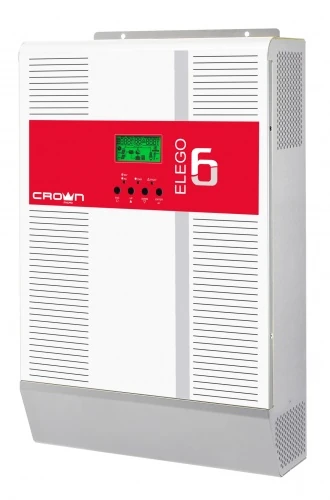
- 6 kW hybrid
- IP21 indoor only
- 4-year listing tag
- Wi-Fi monitoring
- 5-inch LCD touchscreen
Nexus 6kW
Hybrid · IP66 · 200% PV
Rs 203,000
Rs 33,833/kW
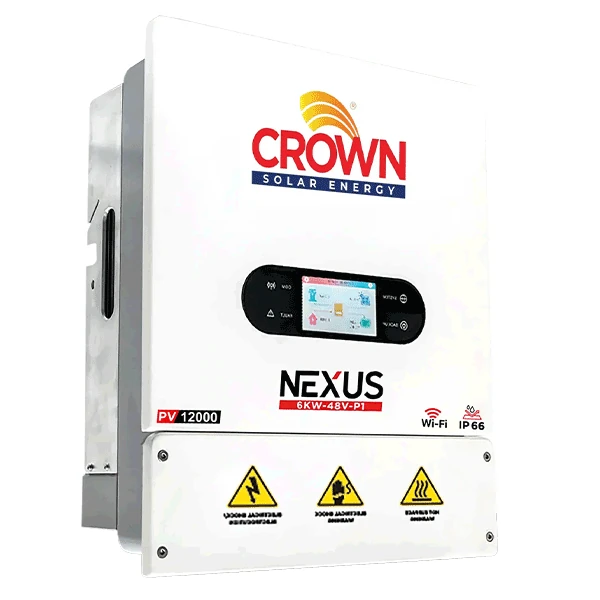
- 6 kW hybrid
- IP66 sealed
- 200% PV oversizing
- Dual 18A MPPT
- Dual output
Nova 9.8kW
Hybrid · IP21 · 4-year tag
Rs 250,000
Rs 25,510/kW

- 9.8 kW hybrid
- IP21 indoor only
- 4-year listing tag
- RGB status lights
- Large-home backup
Nova 12.6kW
Hybrid · IP21 · 6-year tag
Rs 390,000
Rs 30,952/kW

- 12.6 kW hybrid
- IP21 indoor only
- 6-year listing tag
- Dual output
- Large home + small commercial
Nexus 12kW 3Ph
Hybrid · 3-phase · IP66
Rs 494,999
Rs 41,250/kW
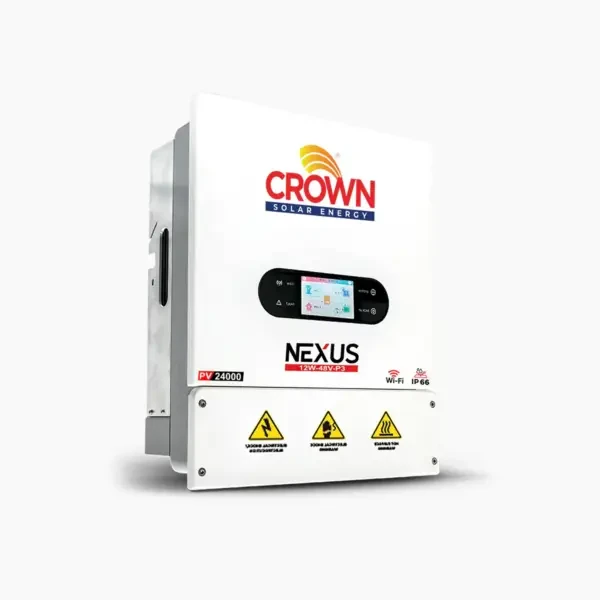
- 12 kW hybrid
- Three-phase
- IP66 sealed
- 200% PV oversizing
- Commercial sites
Voltmore 12kW
On-grid · 3-phase · IP66
Rs 177,000
Rs 14,750/kW

- 12 kW on-grid
- Three-phase
- IP66 sealed
- 10-year listing tag
- Net metering ready
Voltmore 15kW
On-grid · 3-phase · IP66
Rs 212,000
Rs 14,133/kW
- 15 kW on-grid
- Three-phase
- IP66 sealed
- 10-year listing tag
- Lowest rate on the page
The Cheapest Way Into a Crown Hybrid
Yorker 2kW — small-home backup
- Fans, lights, TV and laptop
- Small essential-load backup only
- Dual output on the bigger Yorkers
- See the 2 kW card above
Best Value per Kilowatt
Arceus 5.8kW hybrid
- Lowest rupees-per-kilowatt among home hybrids
- A real home size, not a commercial unit
- Badge on the Arceus — the usable size
- Best budget pick: Yorker Pro 5kW
The Sealed One for Dusty Roofs
Nexus 6kW IP66
- IP66 sealed for outdoor and dusty installs
- 200% PV oversizing for winter haze
- Dual 18A MPPT
- Wrong buy for a clean indoor room
Check Before You Pay
Four quick checks at the shop
- Serial on the side sticker, not the box
- Register at the manufacturer portal
- Hologram and approval certificate
- Computerised invoice with stamp
Crown is the inverter that changed the price of solar in Pakistan. A year ago, very few people asked about the brand; today many solar shops display Crown alongside Inverex, Growatt and Solis. This page lists the crown inverter price in pakistan for every Crown series — Xavier, Yorker, Elego, Nexus, Nova, Arceus and Voltmore — with the same day’s rates in the cards above. The rates match the solar plate price in Pakistan homepage for the same models on the same day, and the solar inverter price in Pakistan hub for the same models.
The cards above are built from the tracker’s live inverter listings — Crown overall across 40 listings, the most-listed local brand on the site. Most cards show one fixed price, because each card is one verified dealer listing for one model. The number under each price — the rupees-per-kilowatt rate — is the price divided by the size. A 5 kW inverter and a 10 kW inverter at the same price are not the same deal: the 10 kW one costs half as much per kilowatt.
The Best Value badge sits on the Arceus 5.8kW. It has the lowest rupees-per-kilowatt rate among the home hybrids on this page, and it is a real home hybrid — a size a medium home can actually use. The two on-grid Voltmore cards show lower rates, but they are commercial three-phase units with no battery input, so they give you no backup during load-shedding.
The Voltmore 15kW is the lowest rate a large home or commercial site could actually use, on-grid only. The Arceus is the best value among the home hybrids with backup.
And one fact worth knowing first: Crown is a Pakistani brand — a locally branded import, not a manufacturer — and the public record does not agree on who exactly “Crown” is. Two names are used interchangeably for the same inverter lines: Crown Solar Energy and Crown Micro / Crown Micro Global. No verified founding year exists, and the relationship between the two is unresolved in public sources. This page states what is verified and says so where it is not — it does not pick one version as fact.
Below the cards you will find the series explained, why the same inverter has different prices, what size you need, how Crown compares with Inverex and the imported brands, and how to check an inverter is genuine. For the other big local brand, see the inverex inverter price in pakistan page, and for backup-only units, the ups price in pakistan page.
How to Read the Crown Inverter Price in Pakistan per Kilowatt
Every card shows a rupees-per-kilowatt rate under the price. This is the simplest way to compare inverters. Kilowatt — written as kW — is how much power an inverter can deliver at one time.
Think of it like the size of a water pipe: a bigger kW means more power flowing at once. To get the rate, divide the price by the kilowatts. An inverter with a lower rupees-per-kilowatt rate gives you more power for each rupee you spend.
But there is a catch. The kW on the label is the maximum output, not the type. A 5 kW hybrid and a 5 kW on-grid inverter at the same price are not the same deal — the hybrid also has a battery input and backup, while the on-grid one switches off when the grid drops.
So compare within the same type first: hybrid against hybrid, on-grid against on-grid. Then compare the per-kilowatt rate. That is why the Arceus 5.8kW wins on rate here, and why the Yorker Pro 5kW is still the cheapest way into a full home hybrid.
Here is a quick example. Imagine two inverters at the same price — one 5 kW, one 10 kW. The 10 kW one costs half as much per kilowatt, because you get twice the power for the same money.
But if the 10 kW one is on-grid and you need backup during load-shedding, it is still the wrong buy. Rate first, type second — and never the other way round.

Eight Crown Lines, Eight Different Deals
Crown sells eight inverter lines, and they are not interchangeable — each one is built for a different home, and the price gaps between them are the point of this page. The cards above show one verified listing per size; the sections below explain what each line is actually for.
Xavier — The Budget Hybrid
Xavier is the budget and entry hybrid. The range runs from a tiny 1.2KVA unit for a couple of fans and lights, up through a 3 kW off-grid unit, to the 6 kW hybrid with a 5-year tag that sits in the cards above.
The Xavier II 6kW is the one to know. Dealer guides put it above the tracker’s Xavier 6kW figure — different listings (Xavier II vs Xavier), report both, never average. One guide calls it the best overall pick for the largest number of Pakistani households: two 1.5-ton inverter ACs, fridge, fans, lighting and the occasional pump start, indoors.
IP21 indoor only, dual MPPT, lithium-ready, with a 5-inch LCD and Wi-Fi monitoring. It works with 12V, 24V and 48V battery systems, and carries a built-in MPPT solar charger.
Yorker — The Budget Pick With Dual Output
Yorker is the budget hybrid. The range runs from the 2 kW unit in the cards above, through a 3.6 kW, to the 5 kW and 6 kW units and the Yorker Pro 6.5kW. Its key feature is dual output — it splits circuits into heavy and essential, so when the grid drops at night the inverter cuts the AC and keeps fans, lights, fridge and router running for hours instead of forty minutes.
It also carries a built-in parallel kit. Strictly a one-AC, indoor-only unit (IP21). One guide’s “Best Budget Pick”. The 2kW runs fans, lights, TV and a laptop — small essential-load backup only.
The 5kW is the practical inverter for the average Pakistani household: fridge, washing machine, LED lighting, fans, TV, kitchen appliances and one inverter AC. One honest distinction: the hub page’s Yorker 5kW (48V) and this page’s Yorker Pro 5kW are different models — same size, different listings — so compare the exact model number, not just the size.
Elego — The Mid-Range Hybrid
Elego is the mid-range hybrid. The range runs from the 6 kW unit in the cards above, through the Elego Star 6.5kW with dual MPPT and built-in Wi-Fi, to the Oyster 6.5kW and Oyster 10kW, and up to the 20 kW and 30 kW high-voltage commercial units.
Pure sine wave, Wi-Fi monitoring, 5-inch LCD touchscreen, parallel operation up to 9 units, and a battery-independent design — it works without batteries in sunny hours. The Oyster line is the high-voltage commercial line: a wide battery range, triple MPPT, IP66, up to 10 units in parallel, and a 10-year tag — and it pairs with high-voltage batteries, NOT standard 48V ones.
The Elego 6kW carries a conflict: the tracker lists it below two dealer guides — report all three, never average. And one guide’s Elego 10kW figure has no tracker corroboration at all — a guide figure, not a verified rate, and a different model from the Oyster 10kW.
Nexus — The Premium Sealed Hybrid
Nexus is the premium sealed hybrid. The range runs from the 6 kW unit in the cards above, through an 8 kW, to the 12 kW three-phase unit and a 12 kW single-phase unit. IP66, dual 18A MPPT, 200% PV oversizing — up to 12 kW of plates on a 6 kW inverter, which is how you keep generating through December haze — and dual output.
One guide calls it “the cheapest properly sealed hybrid that does not feel like a compromise” and “genuinely the wrong buy for a clean indoor room” — the premium over the Yorker buys survivability you will not need indoors. The 10kW on-grid Nexus is a guide figure only, with no tracker listing.
The Nexus 8kW suits larger homes, offices, clinics, schools and small commercial sites — 2–3 ACs running in the day plus water pumps and heavy loads.
Nova — The Large-Home Hybrid
Nova is the large-home hybrid. The range runs from an 8.2kW with a 4-year tag, through the 9.8kW in the cards above, to the 12.6kW with a 6-year tag. RGB status lights, dual output, built-in Wi-Fi, mobile monitoring, USB on-the-go charging.
It works best with the Crown CLB battery — though no verified price for the Crown CLB battery was found anywhere, so this page states that honestly. The Nova 9.8kW carries a conflict: the tracker lists it below two dealer guides, and one marketplace listing sits far above the dealer listings — a single-dealer outlier, flag it, do not headline.
The Nova 8.2kW is the same story: the tracker lists it below two dealer guides.
Arceus — The Middle Ground
Arceus is the middle ground: a 5.8kW hybrid with a 4-year tag on the tracker, against a higher figure on two dealer guides. One guide calls it “the perfect middle ground” between Yorker and Elego for medium homes — the size between the Yorker 5kW and the Elego 6kW, at a price between them on the tracker listing.
And it carries the Best Value badge on this page: the lowest rupees-per-kilowatt rate among the home hybrids in the cards above.
Voltmore — On-Grid, Cheapest Per kW
Voltmore is the on-grid line: a 12 kW three-phase unit and a 15 kW three-phase unit, both IP66 with a 10-year tag — the cheapest on-grid per kW in the Crown range. On-grid units have no battery input: they convert DC to AC, feed the home and the grid, and export surplus through net metering — and they switch off during load-shedding, which is anti-islanding, a safety rule, not a fault.
Voltmore’s two cards are above — the cheapest per kilowatt in the Crown range. If you only want lower daytime bills and never need backup, Voltmore is the line to ask your dealer about.
Relevo and PRIDOR — Off-Grid and Pumps
Relevo is the off-grid and UPS line: a 1400VA unit and a 2500VA unit — instant switching, smart battery charging, compact wall-mount design. One guide’s figure for the 2500VA model is an obvious error and is not used on this page.
PRIDOR is a 15kW solar pump inverter for agriculture and irrigation, with three-phase pump compatibility — named by one dealer, with no price anywhere. Crown Micro small inverters appear only on a months-old guide — stale, cross-check only.
Xavier, Yorker, Elego and Nexus Side by Side
Four series, four different deals. The table below is the consensus across the sources opened for this page.
| Series | Type | Sizes | IP rating | Warranty tag | Best for |
|---|---|---|---|---|---|
| Xavier | Hybrid + offgrid | 1.2–6 kW | IP21 | 5Y | Budget — best overall pick (Xavier II 6kW) |
| Yorker | Hybrid | 2–6.5 kW | IP21 | — | Budget — dual output, one-AC homes |
| Elego | Hybrid (Oyster HV) | 6–30 kW | IP21 / IP66 | 4Y / 6Y / 10Y / 5Y | Mid-range — up to commercial HV |
| Nexus | Hybrid | 6–12 kW | IP66 | — | Premium sealed — dusty and outdoor installs |
Xavier is the cheapest way into a Crown hybrid with a 5-year tag. Yorker is the budget pick with the dual output that keeps essential loads running for hours at night. Elego spans the widest range — from the 6 kW home unit to the 30 kW high-voltage commercial unit — and its Oyster line is the only Crown line with a 10-year tag.
Nexus is the only fully sealed line: IP66, 200% PV oversizing, dual output — and the only one that makes sense outdoors. For the series-by-series comparison with Inverex, see the inverex inverter price in pakistan page.
Six Reasons One Crown Inverter Has Six Different Prices
When you compare the crown inverter price in pakistan across shops, remember you are comparing more than a price tag. Six things move the price of the same Crown inverter, and none of them is the inverter itself:
- Series and IP premium: the same 6 kW can cost very different amounts as a Yorker, a Xavier, an Elego or a Nexus — the premium buys IP66 sealing, a longer warranty tag, more MPPT capacity and more PV input, not more kilowatts.
- Dealer spread: the same model can cost one figure on the tracker and a much higher figure on two guides — the Arceus 5.8kW. Always get two quotes for the exact model number.
- Daraz pattern: daraz single-dealer prices run well above dealer listings for the same model — the Elego 6kW and the Nova 9.8kW both carry marketplace listings far above the dealer listings. Never treat a daraz listing as the market rate on its own.
- The 2× guide conflict: one price guide’s capacity table runs about 2× the tracker dealer listings across every size. It appears to quote premium/IP66 models as the “6kW” price. This page uses the tracker dealer listings.
- Three-phase premium: three-phase hybrid and on-grid units cost far more per kW than single-phase — the Nexus 12kW three-phase hybrid costs roughly double the single-phase 9.8kW Nova, while the single-phase 9.8kW Nova covers a large home on its own.
- Warranty-tag premium: the per-model tags from the tracker run from 4 years (Elego, Nova) to 5 years (Xavier, Elego 20/30kW) to 6 years (Elego Star, Nova 12.6kW) to 10 years (Elego Oyster, Voltmore). Brand-level claims range 1–5 years and conflict — one site says “one year”, another says “2–3 years”, another says “3–5 years”. This page states the per-model tags and notes the conflict.
Sizing a Crown Inverter to Your Home’s Load
Size the inverter to your load, not to your budget. A too-small inverter trips on motor starts; a too-big inverter wastes money. And the rule every source uses is the same: continuous load × 1.25 margin, and never select an inverter at exactly 100% of load. Then check motor starts: a fridge compressor draws about 3× its running watts, a 1 HP water motor about 3×, an inverter AC soft-starts at about 1.5×.
Take the larger of (continuous × 1.25) and (running load + largest motor’s start surge). Worked example: 3 fans, 6 LED bulbs, TV, fridge, 1.5-ton inverter AC, laptop and router = 2,114 W running. × 1.25 = 2,643 W; at motor start 2,864 W — so buy a 3 kW inverter. Then check the crown inverter price in pakistan for that size in the cards above.
The 1.25 Rule — Size to Your Load, Not Your Budget
Continuous load × 1.25 is the margin; motor start is the check. A fridge compressor draws about 3× its running watts, a 1 HP water motor about 3×, an inverter AC soft-starts at about 1.5×. Size before brand: get the house sized first, then pick the brand.
Crown Size by Home Size
| Home | Load | Crown size |
|---|---|---|
| Small home | Lights, fans, Wi-Fi router, TV | Yorker 2kW / Xavier 3kW |
| Medium home | 1 inverter AC, fridge, fans, lights | Yorker 5kW / Xavier II 6kW |
| Large home | 2 ACs, fridge, water motor, fans, lights | Nexus 6kW / Nova 8.2kW |
| Commercial | Shops, offices, factories — 3-phase loads | Nexus 12kW 3Ph / Elego 20–30kW HV |
How Many Plates Per Crown Inverter
Plate DC should be ≥ inverter AC, with a DC/AC ratio of 1.15–1.3 — the sweet spot across every source. A 5 kW inverter takes 5–6.5 kW of plates (9–11 × 585W); a 6 kW inverter takes 6–7.8 kW (11–13 × 585W). The Nexus 6kW is the exception that proves the rule: it supports 200% PV oversizing, up to 12 kW of plates on a 6 kW inverter — how you keep generating through December haze.
Oversizing far beyond that causes more clipping losses — a 5 kW inverter with a 10 kW array is far too much, and the extra plates’ output is simply lost. The PV input limit decides your maximum plate count — check the exact model, as several variants exist around the 6 kW rating with different PV input limits.
Single-Phase or Three-Phase — Which Crown Fits
Single-phase Crown inverters cover up to about 10 kW; three-phase is needed above a 7 kW sanctioned load, above 8–10 kW, and for factories and commercial sites. Do NOT use three single-phase inverters — it voids NEPRA approval and creates load imbalance. And the inverter’s AC output must be ≤ your DISCO sanctioned load — a NEPRA 2026 requirement.
One AC or Two — Which Crown Size?
A 1.5-ton inverter AC is about 1,500 W rated — 1.9 kVA alone, so 2 kW minimum; with fans, lights, fridge, laptop and router, 2.9 kVA — so 3 kW. Two ACs need 5 kW. A 3.6kW Yorker runs an apartment or small house with moderate consumption — fans, LED lights, TV, internet and fridge.
A 5kW Yorker or 6kW Xavier II runs a medium home with one inverter AC. A 6kW Nexus runs a larger house with multiple inverter ACs, fridges, lighting and kitchen appliances. Or work it out with the solar load calculator.

Crown Against Inverex and the Imported Brands
Crown and Inverex are the two Pakistani inverter brands buyers actually compare — and the imported names sit above both on price. The table below is the consensus across the sources opened for this page. One comparison table on the web is WRONG and is not repeated here: it claims Crown has “superior build quality”, “longer warranties and better after-sales service” than Inverex, a Crown warranty of 2–3 years against Inverex 1–2 years, Inverex service “limited to major cities”, and price ranges that contradict the verified evidence. The Nitrox 5-year warranty alone disproves the warranty claim.
| Brand | Origin | Peak efficiency | Warranty | Service network | Best for |
|---|---|---|---|---|---|
| Crown (Xavier / Nexus) | Pakistan (imported) | 97.5% | 4–10Y by model tag | Thinner outside big cities | Best value hybrid |
| Inverex (Nitrox) | Pakistan (imported) | 97.8% (up to 98% claimed) | 5 years | Deepest in Pakistan | Deepest service network |
| Huawei | China | 98.8% | 10 yrs (extendable to 20) | Authorised dealers | Premium on-grid |
| Growatt | China | 98.0% | 10 yrs vs 5 yrs (conflict) | Authorised dealers | Value imported |
| Solis | China | 98.7% | 10 yrs vs 5–10 yrs (conflict) | Authorised dealers | Hybrid, installer favourite |
When you compare the crown inverter price in pakistan with Inverex, the gap is service, not quality. Crown undercuts imports by 20–30%, and Inverex costs 10–25% more than Crown at equivalent capacity — that premium is largely paying for service coverage. The exception is the 6kW IP65 Nitrox against the Crown Nexus IP66, where the two sit close together on rate.
Crown wins on price, on IP66 (the Nexus line goes to IP66 against Nitrox’s IP65), and on firmware and features per rupee. Inverex wins on service depth outside the big three cities and on the 5-year Nitrox warranty. In Lahore, Karachi and Islamabad the service gap narrows considerably, because Crown stocks parts locally in the major cities — for most buyers in or near a major city, the thinner Crown network rarely matters in practice.
Outside the big three, the difference becomes the whole decision. The imported brands win on peak efficiency — Huawei at 98.8% against Crown at 97.5% — but at a far higher price. Full Inverex rates are on the inverex inverter price in pakistan page, and the category hub on the solar inverter price in Pakistan page.
Inside a Crown Inverter — The Tech in Plain Words
Before you compare the crown inverter price in pakistan across series, it helps to know what the numbers on the box mean. Four things decide how a Crown inverter behaves on your roof and in your home.
Dual MPPT — One Per Roof Face
Dual MPPT is standard on the Xavier II, Elego Star and Nexus — one MPPT per string orientation, so a roof with more than one face gets full output from both faces. The Nexus 6kW carries dual 18A MPPT. If your roof faces two directions, you need two MPPTs — a single-MPPT inverter wastes the output of one face.
IP21 or IP66 — The Spec That Decides Where It Lives
This is the single most important spec difference in the Crown range. Xavier, Yorker, Arceus and Nova are IP21 — indoor only, no dust or water sealing. Nexus and the Elego Oyster line are IP66 — fully sealed for outdoor and dusty installs.
Dust is what actually kills inverters in Pakistan, not age, so an IP66 unit mounted outdoors will outlast an IP21 unit mounted in the sun. An inverter on a south-facing wall in June can see ambient above 50°C — choose a shaded, ventilated mounting location. And one guide’s warning is worth hearing: the Nexus is “genuinely the wrong buy for a clean indoor room” — the premium over the Yorker buys survivability you will not need indoors.
Wi-Fi and the Phone App
Crown inverters carry Wi-Fi monitoring and mobile apps — generation, battery charge, grid export and faults on your phone. The Xavier II 6kW carries Wi-Fi monitoring and a 5-inch LCD; the Elego carries Wi-Fi and a 5-inch LCD touchscreen; the Nova carries built-in Wi-Fi, mobile monitoring and USB on-the-go charging.
Check that the app works with the exact model before you buy: some older variants need a separate WiFi dongle, and some grey-market units arrive without one.
Which Battery Pairs With a Crown
Crown inverters are lithium, lead-acid and gel compatible with real BMS communication — but the battery must talk to the inverter’s battery management system over CAN or RS485, and a “lithium compatible” label alone is not enough. Check the inverter’s approved battery list and get written compatibility confirmation.
The Nova works best with the Crown CLB battery, though no verified price for the Crown CLB battery was found. The Oyster line pairs with high-voltage batteries, NOT standard 48V ones — a 48V pack on an Oyster is a mismatch. For systems below 10 kW, 48V LFP is the standard; for larger systems, 400V high-voltage.
Full battery rates are on the lithium battery price in pakistan page and the tubular battery price in pakistan page. Never mix lithium and tubular batteries on one inverter.
Four Checks Before You Pay for a Crown
Checking the crown inverter price in pakistan is only half the job. The other half is making sure the inverter in your hands is genuine. Fake and refurbished inverters are common in every bazaar, and they look right until they die in six months. Here are the checks that matter.
1. Serial Number on the Side Sticker — Not the Box
Ask for the exact model number on the quotation and check it matches the label on the unit. Locate the serial number on the inverter’s side sticker, not the box — box labels are easily switched. Note the serial number and keep it with your invoice.
2. Warranty Registration
Ask how the warranty is registered and keep the warranty paperwork. All warranties require registration at the manufacturer portal within 30 days of installation. A genuine serial completes registration; a fake returns “invalid SN” or “already registered elsewhere”.
DIY installation voids warranties, and warranty claims require proof of purchase and installation records. Check the per-model tag for your exact model — Xavier 5Y, Arceus 4Y, Elego 4Y, Elego Star 6Y, Elego Oyster 10Y, Nova 4Y, Nova 12.6kW 6Y, Voltmore 10Y, Elego 20/30kW 5Y.
3. Authorised Dealer Check
Buy from an authorised dealer. Named dealer areas on one guide: Saddar Electronics Market and Shershah Market in Karachi, Hall Road and Liberty Market and Johar Town in Lahore, Blue Area and F-10 in Islamabad — their claim, not independently verified.
Crown’s service network is thinner in smaller cities than Inverex — but Crown stocks parts locally in the major cities, which narrows the gap in Lahore, Karachi and Islamabad.
Grey-Market Warning
Be cautious of unusually low prices from unknown sellers, or used units sold as new. Fake and grey-market units exist — buy from an authorised dealer, verify the serial, check the anti-counterfeit hologram, and keep the computerized invoice and warranty card with a matching serial.
Grey-market units — bought in bulk from clearance sales or unauthorised distributors abroad — have no functioning warranty path once they land in Karachi. A low quote for a branded unit deserves a check for authenticity.

Fitting Your Crown — Mounting, Wiring and Protection
Single-phase Crown inverters cover up to about 10 kW; three-phase is needed above a 7 kW sanctioned load, above 8–10 kW, and for factories and commercial sites. Mount the inverter in shade, with ventilation, and never in direct sun on a south-facing wall — an inverter on a south-facing wall in June can see ambient above 50°C.
Between the plates and the inverter, and between the battery and the inverter, NEPRA’s 2026 rules and the PEC code require a DC isolator, a DC breaker, a DC surge protector, a DC fuse and cabling. Every reputable inverter warranty requires this protection. A battery isolation switch (PEC-required visible-break disconnect) combines the isolator and the breaker.
Ask your installer for the protection cost in writing, because a missing breaker can void the inverter warranty. A residential install takes about 4–6 hours. Get a free site survey before you buy — the installer sizes the inverter to your load, your roof and your sanctioned load, not to a catalogue page.
Which Battery Works With Your Crown?
The battery must match your inverter’s voltage and charging settings. For systems below 10 kW, 48V LFP is the standard; for larger systems, 400V high-voltage. The battery must talk to the inverter’s BMS over CAN or RS485 — a “lithium compatible” label alone is not enough; check the inverter’s approved battery list and get written compatibility confirmation.
Never mix lithium and tubular batteries on one inverter: their charge profiles are different, and mixing them damages both. Between the battery and the inverter, NEPRA’s 2026 rules and the PEC code require a DC isolator, a DC breaker, a DC surge protector, a DC fuse and cabling — ask your installer for that protection cost in writing, because a missing breaker can void the battery warranty.
Compare battery rates on our lithium battery price in Pakistan page, our tubular battery price in Pakistan page, and our phoenix battery price in Pakistan page before you choose.
What Your Crown Quote Should — and Should Not — Include
No inverter-specific GST or duty figure was verified in any source, so this page states none. What is verified is the basis of every figure on this page: the card figures are dealer list prices from the tracker’s live listings and dealer-guide sources, each labelled with its source and date in the research record above.
Always ask your dealer whether the quoted price includes GST and whether it includes installation and delivery — a quote that excludes any of them will look cheaper by exactly that much, and all of them are still payable. For context only: solar plates carry 0% customs duty and 10% GST since July 2025. Dealer guides note only that inverter rates “fluctuate with import duties and exchange rates” — no figure.
About This Crown Inverter Page
Solar Plate Pakistan is an independent price-information website. We are not an authorized dealer or official partner of any brand. The crown inverter price in pakistan on this page comes from dealer listings collected each morning — the tracker’s inverter section (437 listings, 28 brands, live data 11 November 2026, 5:32–5:35 am PKT) — and the same model’s price is matched across this page, the homepage and the brand pages on the same day.
Where a card comes from a dealer guide instead of the tracker, its model line says so. If a size has no verified listing on the day this page is built, it has no card rather than a guessed figure.
Crown is a Pakistani brand — a locally branded import, not a manufacturer — and the public record does not agree on who exactly “Crown” is: two names, Crown Solar Energy and Crown Micro / Crown Micro Global, are used interchangeably for the same inverter lines, no verified founding year exists, and the relationship between the two is unresolved in public sources. This page states what is verified and says so where it is not. The official catalogue is at crownsolarenergy.com.
Questions about this page can be sent through the Contact Us page, or by email at sohaibkhan127222@gmail.com. More about the site on our About Us page and our Our Team page, and read our Disclaimer before you buy.
The rules that govern this page are set by the National Electric Power Regulatory Authority (NEPRA), under the Prosumer Regulations 2026 (S.R.O. 251(I)/2026).
Frequently Asked Questions
What is the crown inverter price in pakistan today?
See the cards at the top of this page for today’s Crown inverter prices. They are updated every morning from dealer listings, and the date is in the heading above them. The cards cover the hybrid line from 2 kW to 12 kW, plus the on-grid Voltmore 12kW and 15kW.
What is the Crown 6kW inverter price in Pakistan?
It depends on the series — see the 6 kW cards at the top of this page. The Yorker 6kW is the cheapest 6 kW, the Xavier 6kW sits in the middle with a 5-year tag, the Elego 6kW adds Wi-Fi and a touchscreen, and the Nexus 6kW is the sealed IP66 unit. The Xavier II 6kW is a different listing from the tracker Xavier 6kW, so compare the exact model number.
What is the Crown 5kW inverter price in Pakistan?
See the Yorker Pro 5kW card at the top of this page — the practical inverter for the average Pakistani household. One guide’s capacity table lists 5kW at about double the tracker dealer listings — it appears to quote premium/IP66 models as the “5kW” price. The Arceus 5.8kW, the next size up, is the Best Value card on this page.
Do Crown inverters support lithium batteries?
Yes — Crown inverters are lithium, lead-acid and gel compatible with real BMS communication. But the battery must talk to the inverter’s BMS over CAN or RS485, and a “lithium compatible” label alone is not enough. The Nova works best with the Crown CLB battery, the Oyster line pairs with high-voltage batteries — NOT standard 48V ones — and you must never mix lithium and tubular batteries on one inverter.
Is Crown suitable for net metering?
Yes, with the right model. On-grid Voltmore units (12kW and 15kW, three-phase, IP66) are built for net metering, and hybrid units export surplus through net metering too — as long as the inverter is NEPRA-approved and its AC output is ≤ your DISCO sanctioned load. Always ask the vendor for the current approval PDF before ordering.
Where can I buy a genuine Crown inverter in Pakistan?
From an authorised dealer. Named dealer areas on one guide: Saddar Electronics Market and Shershah Market in Karachi, Hall Road and Liberty Market and Johar Town in Lahore, Blue Area and F-10 in Islamabad. Verify the serial number on the inverter’s side sticker — not the box — register it at the manufacturer portal within 30 days, and keep the computerized invoice and warranty card with a matching serial.
What is the best hybrid inverter in Pakistan for a normal home in 2026?
For the largest number of Pakistani households, one guide’s pick is the Crown Xavier II 6kW — two 1.5-ton inverter ACs, fridge, fans, lighting and the occasional pump start, indoors. For the cheapest full home hybrid, the Yorker 5kW; for dusty or outdoor mounting, the Nexus 6kW IP66. Size the house first, then pick the brand.
What is the best cheap hybrid inverter in Pakistan?
The Crown Yorker 2kW for small essential-load backup, and the Yorker 5kW for a full home. Crown is Pakistan’s best-selling value hybrid — it undercuts imports by 20–30%. But cheap is not always the right buy: a too-small inverter trips on motor starts, and an IP21 unit mounted outdoors will die of dust.
Is a more expensive hybrid inverter always better?
No. The Nexus 6kW IP66 costs far more than the Yorker 6kW — and one guide calls it “genuinely the wrong buy for a clean indoor room”, because the premium buys survivability you will not need indoors. What matters is fit: the right size (continuous load × 1.25 + motor start), the right IP rating for where it will be mounted, and the right warranty for the model you buy.
How many solar plates can a 3 kW inverter take?
About 3–3.9 kW of plates — roughly 6 × 585W — at a DC/AC ratio of 1.15–1.3. A 5 kW inverter takes 5–6.5 kW of plates (9–11 × 585W), and a 6 kW inverter takes 6–7.8 kW (11–13 × 585W). The Nexus 6kW is the exception: it supports 200% PV oversizing, up to 12 kW of plates on a 6 kW inverter — but the PV input limit still decides your maximum plate count, so check the exact model.