
Lithium Ion Battery — How It Works, Its Types, and How Long It Lasts

If you are shopping for a lithium ion battery for your home, you have probably heard ten different opinions already. One shopkeeper says lithium is the only battery worth buying. Another says it is not safe indoors. A neighbour says his lithium battery has run for years without a single top-up of water.
All three can be right — because they are talking about different types of lithium batteries, used in different ways. This guide sorts that out in plain words.
You will learn how it works inside, the two types that matter for a Pakistani home, how long one lasts, whether it is safe in your house, and what size you need. No engineering degree needed — just simple words and real examples.
By the end, you will know which type to ask for, which questions to ask the seller, and which mistakes to avoid before you pay. Let us start with the short answer.
Lithium Ion Battery — The Short Answer
Here is the short answer. A lithium ion battery is a rechargeable battery that stores electricity using tiny lithium particles moving back and forth inside it. You charge it in the daytime from your solar plates, and it gives the power back at night or during load-shedding.
For a Pakistani home, one type stands out: LFP, short for lithium iron phosphate. It lasts the longest, handles heat the best, and is the safest type to keep inside a house. The other common type, NMC, packs more power into a smaller box, but it wears out faster and needs more care.
Here is how the main options compare — without any prices, because prices change with the dollar rate and the model. For today’s prices, follow the link under each type below.
| Battery type | How long it lasts | Usable power | Heat safety | Water top-up | Best for |
|---|---|---|---|---|---|
| LFP lithium | About 3,000–6,000+ charge cycles | About 80–100% of its size | Very stable in heat | Never | Home solar backup |
| NMC lithium | About 1,000–2,000 charge cycles | About 80–100% of its size | Needs more care | Never | Small spaces, light weight |
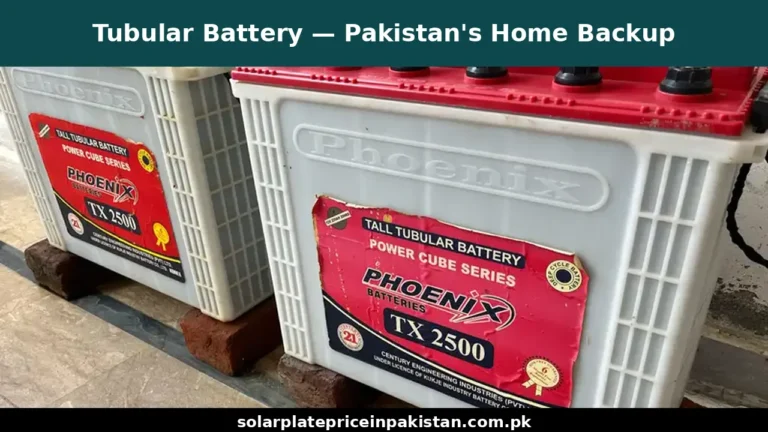
| Tubular lead-acid | About 1,000–1,500 charge cycles | About 50–60% of its size | Handles heat, but vents gas | Every few weeks | Tight budgets, old UPS setups |
One line in that table decides most purchases. A tubular battery lets you use only about half its stored power safely, while a lithium battery lets you use nearly all of it. That is why a smaller lithium battery can run the same fans and lights as a bigger tubular one.
What Is a Lithium Ion Battery?
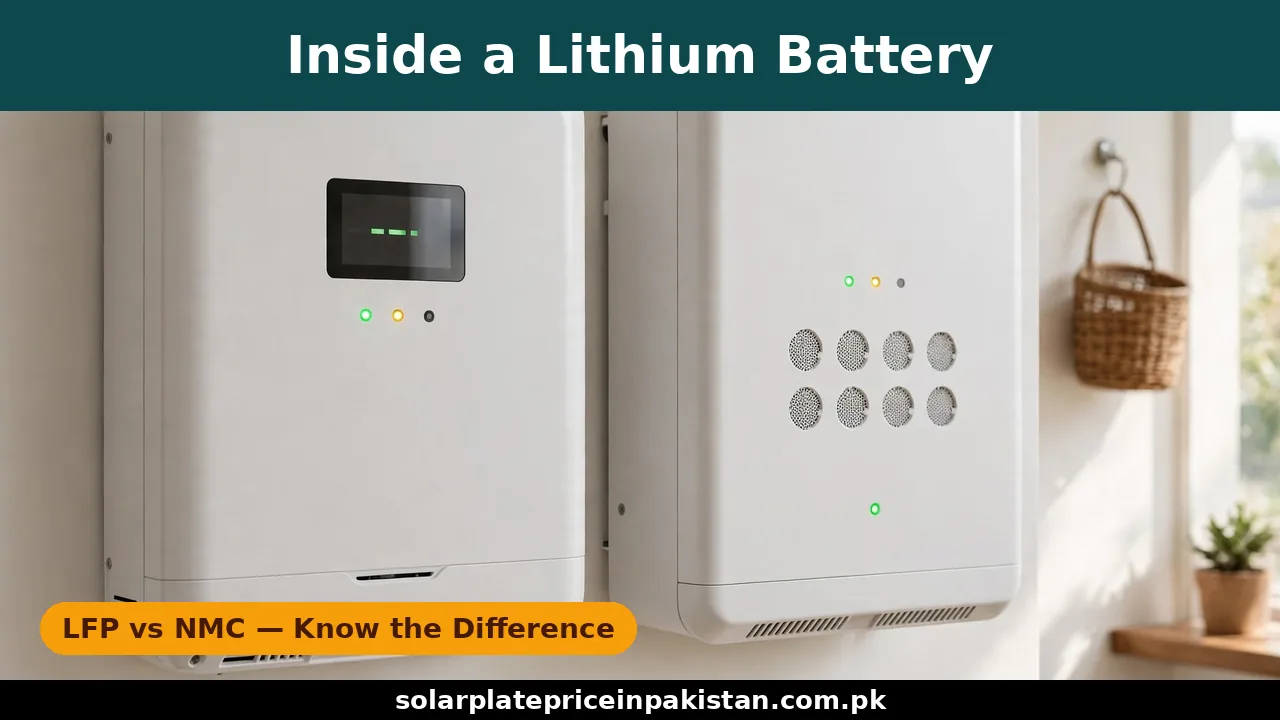
A lithium-ion battery is a rechargeable battery. Inside it, tiny charged particles of lithium move from one side to the other when you charge it, and move back when you use the power. That back-and-forth movement is the whole trick. It is the same idea that powers your mobile phone, your laptop, and most electric bikes — only bigger, for your home.
The word “ion” sounds hard, but it just means a tiny particle with an electric charge. Think of it like a small delivery van carrying charge from one side of the battery to the other. When the vans drive one way, the battery charges. When they drive back, the battery gives power to your home.
People sometimes mix up two names. “Lithium battery” is the big family name. “Lithium-ion battery” is the rechargeable part of that family. The small coin cells in a watch are lithium batteries too, but you cannot recharge them. For home solar, you only ever want the rechargeable kind.
How Does a Lithium Ion Battery Work?
Every lithium-ion battery has four parts inside, sealed in a box. Once you know the four parts, the whole thing makes sense.
The four parts inside every cell
First, the cathode — the positive side. Second, the anode — the negative side, usually made of graphite, the same material in a pencil. Third, the electrolyte — a liquid that lets lithium particles travel between the two sides. Fourth, the separator — a thin sheet that keeps the two sides from touching while still letting the particles pass through.
On top of these four parts, a home battery has a fifth part: the BMS, short for battery management system. Think of the BMS as a guard standing at the gate. It watches the voltage, the current and the temperature all the time, and it cuts the power off if anything goes outside the safe range.
Charging — the particles move one way
When your solar plates make extra power in the daytime, your inverter sends it to the battery. The power pushes the lithium particles from the cathode to the anode, where they sit between the layers of graphite, waiting. The battery is now full, like a water tank filled in the morning.
This is why a lithium battery charges so fast. The particles are small and the path is short, so the tank fills quickly. A full charge from empty usually takes only a few hours of good sunlight.
Discharging — the particles move back
At night, or when the grid goes off, the battery gives the power back. The lithium particles travel back through the liquid to the cathode, and as they move, they push electrons through the wires outside the battery. Those electrons are the electricity that runs your fans, lights and fridge.
This back-and-forth can repeat thousands of times. Each full charge and discharge is called a cycle. A battery rated for 6,000 cycles can go through that full trip 6,000 times before its capacity drops to about 80% of what it was on day one. Half trips count as half cycles.
What the BMS does for you every day
The BMS does six quiet jobs. It stops overcharging, stops deep discharge, stops too much current, stops short circuits, watches for overheating, and watches for overcooling. It also balances the cells, so no single cell inside the pack gets overworked while the others rest.
You will never see the BMS work, and that is the point. When it does its job, the battery just works, day after day. If a seller offers you a lithium battery and cannot tell you about its BMS, walk away.
The Main Types of Lithium Ion Battery
Not all lithium-ion batteries are the same. There are six main recipes, but only two matter for a home in Pakistan. The rest are for phones, power tools, buses and special jobs.
LFP — lithium iron phosphate, the home favourite
LFP is the recipe behind almost every lithium solar battery sold in Pakistan today. Its cathode is made of iron and phosphate — plain, stable materials. It holds a little less power for its weight than the other types, but for a battery that sits in one place in your home, weight does not matter.
What matters is life and safety. An LFP battery is commonly rated for about 3,000 to 6,000 or more cycles, which is several times longer than the other home options. It also stays stable in heat, which matters a lot in Pakistan, where a battery room can get very hot in June. For solar storage and UPS backup, LFP is the usual choice.
One LFP cell gives about 3.2 volts. Four cells in a row make a 12-volt pack, eight make 24 volts, and sixteen make 48 volts. That is why most home solar systems use a 48-volt LFP battery — sixteen cells, one BMS, and a long, quiet life.
NMC — nickel manganese cobalt, the compact one
NMC packs more power into a smaller and lighter box. That is why it is used in electric cars, e-bikes and phones, where every kilogram matters. One NMC cell gives about 3.6 to 3.7 volts, so a 48-volt pack needs only thirteen cells instead of sixteen.
The trade is life and care. An NMC battery is commonly rated for about 1,000 to 2,000 cycles — still good, but far fewer than LFP. It also needs tighter safety control, because its cathode can release oxygen when it gets very hot, which is what feeds a fire. In a home, where the battery sits in one place and weight does not matter, LFP usually wins.
NMC also uses cobalt, a costly metal with a troubled supply chain. The US Department of Energy explains why battery makers are working to use less cobalt or none at all — one more reason the home market has moved toward LFP, which uses no cobalt and no nickel.
The other four recipes, in short
LCO, or lithium cobalt oxide, is the recipe in most phones and laptops — lots of power in a thin pack, but a short life and the lowest heat tolerance of the family. You will not find it in a home solar battery. LMO, or lithium manganese oxide, is used in power tools and some medical devices: strong bursts of power, but less energy and a faster age than LFP.
NCA, or nickel cobalt aluminium oxide, is the high-performance recipe in some electric cars — lots of power, but it needs careful control and cooling, too demanding for a simple home setup. LTO, or lithium titanate, charges extremely fast and lasts an extremely long time, but it holds the least power of all. You will see it in buses and grid storage, not in a home.
Which lithium ion battery type suits a Pakistani home?
For nearly every home, the answer is LFP. It lasts the longest, it is the safest indoors, it needs no maintenance, and it is the type your solar installer already knows how to fit. Ask for LFP by name when you talk to a seller.
NMC makes sense only in one case: when space or weight is a real problem, such as a small flat with no spare corner, or a portable power station you carry around. For a fixed battery on a wall or in a store room, the extra life of LFP beats the smaller size of NMC every time.
See today’s options on the lithium battery price page, which lists the lithium models sold in Pakistan with their sizes and features.

Lithium Ion Battery vs Tubular Battery
Most Pakistani homes already know the tubular battery. It is the tall, heavy battery that has run UPS systems for years. So the honest question is: what does lithium do better, and what does it do worse?
First, usable power. A tubular battery should not be drained below about half its charge, or its life drops fast. A lithium battery can safely use about 80 to 100% of its stored power. That means a lithium battery of a given size runs your home longer than a tubular battery of the same size.
Second, speed. A lithium battery charges much faster and wastes less power on the way in and out — about 90 to 95% of the power you put in comes back out. A tubular battery wastes more, so you need more solar plates to fill it.
Third, maintenance. A tubular battery needs water top-ups every few weeks, and its terminals need cleaning. A lithium battery needs nothing — no water, no cleaning, no acid smell. You fit it on the wall and forget about it, except for a quick look at its display now and then.
Fourth, life. A good tubular battery lasts about 1,000 to 1,500 cycles with care. A good LFP battery lasts about 3,000 to 6,000 or more. That is the difference between replacing a battery every few years and fitting one that may outlast your inverter.
Where does tubular still win? Upfront cost and repair. A tubular battery is simpler, and any UPS shop in any town can fix or replace it. A lithium battery needs a matching inverter and a working BMS, and not every small shop can repair it yet. If your budget is very tight and your load is small, tubular is still a fair choice. Read the full tubular guide in our tubular battery article before you decide.
How Long Does a Lithium Battery Last?
A lithium battery does not die on one fixed day. It slowly loses capacity, like a water tank that shrinks a little every year. Makers usually rate the life in cycles, and they call the battery “done” when it holds about 80% of its original power. It still works after that — it just holds less.
For most home batteries, the honest answer is 10 to 15 years of daily use. That comes from two clocks running at the same time. The first clock is cycles: each full charge and discharge wears the cells a little. The second clock is calendar age: the battery ages slowly even when it sits unused, because the chemistry inside never fully stops.
Three things decide which clock runs faster. Heat is the first — a battery kept in a hot, closed room ages faster than one kept in a cool, airy corner. Deep discharge is the second — draining the battery to empty every night wears it faster than using only the top half. Charging habits are the third — a battery left at 100% charge in high heat for weeks ages faster than one kept in the middle range.
You can slow both clocks down. Keep the battery in the coolest corner of the house, out of direct sun. Do not drain it to empty every night if you can avoid it. Let the BMS do its job, and do not bypass it.
Is a Lithium Ion Battery Safe at Home?
This is the question every buyer asks, and it deserves a straight answer. Most of the scary battery fire stories you see online are about a different recipe — NMC or NCA cells in phones, laptops and electric cars. The recipe used in home solar batteries in Pakistan is LFP, and it behaves very differently.
The difference is in the cathode. In an NMC cell, the cathode can release oxygen when it gets very hot, and oxygen feeds a fire. In an LFP cell, the phosphate cathode holds on to its oxygen. In abuse tests, NMC cells typically start a runaway reaction somewhere around 150 to 200 degrees, while LFP cells generally do not start the same reaction until well past 270 degrees — a much higher bar, and much harder to reach in a normal home.
That does not mean any lithium battery is automatically safe. Safety comes from three things together: the recipe, the BMS, and the fitting. A genuine LFP battery with a working BMS, fitted by a careful installer with the right cables and a proper breaker, is a safe home appliance. A cheap pack with no BMS, loose cables and no breaker is a risk, whatever recipe it claims to be.
Where should you put it? Indoors is fine for LFP — a dry corner of a room, a store, or a shaded veranda, away from direct sun and away from gas cylinders and stoves. Keep it off the floor if your area floods, and leave space around it so air can move. Do not cover it with cloth or boxes. If the battery ever smells strange, swells, or gets hot to the touch, switch it off at the breaker and call your installer the same day.
What Size Lithium Ion Battery Does Your Home Need?
Battery size is measured in kilowatt-hours, written as kWh. One kWh is one unit of electricity — the same unit on your electricity bill. A 5 kWh battery holds about 5 units. A 10 kWh battery holds about 10 units.
To pick a size, start with your night load, not your day load. In the daytime your solar plates run the house directly. The battery only needs to cover the evening and night, plus load-shedding hours. Add up the fans, lights, fridge and TV you run after sunset, and how many hours each one runs.
Here is a worked example. A home with four fans, ten lights, a fridge and a TV uses roughly 4 to 5 units in a full night, so a 5 kWh lithium battery covers that night — you can use nearly all of its stored power. Add one air conditioner running all night and you need roughly double that.
Do not guess from a neighbour’s battery. Your fans, your fridge and your hours decide your size. Use the solar load calculator to add up your own appliances first — it takes five minutes and stops you buying a battery that is too small or too big. And check that your inverter can handle the battery you pick: compare inverter options on the solar inverter hub page before you commit, because the inverter and the battery must speak the same language.
How to Look After Your Lithium Battery
A lithium battery asks for very little, but a little care goes a long way. The first rule is about heat. Keep the battery in the coolest part of the house. A store room with a small vent is better than a tin-roofed corner that bakes all afternoon.
The second rule is about charging. Let the inverter and the BMS manage the charge. Do not set the charge voltage higher than the maker says, and do not use a charger made for a different battery type — an LFP battery and an NMC battery need different settings, and the wrong setting overcharges the cells.
The third rule is about rest. If you go away for weeks, leave the battery at about half charge, not full and not empty. A battery stored at half charge in a cool room ages the slowest.
The fourth rule is a quick monthly look. Check the display or the app once a month. The voltage should be steady, no cell should be far from the others, and the temperature should be near room temperature. If anything looks odd — one cell much lower than the rest, or the battery hot when it should be cool — call your installer before it becomes a problem.
Mistakes to Avoid When Buying a Lithium Battery
Most bad lithium purchases fail in the same few ways. The most expensive mistake is not picking the wrong brand — it is skipping the checks around the brand.
Buying a battery with no proper BMS
Some cheap packs have a weak BMS or none at all. Without it, there is nothing to stop overcharging, deep discharge or a short circuit. Ask the seller to show you the BMS protections in writing. If they cannot, the battery is not worth the risk.
Mixing the wrong charger or inverter settings
LFP and NMC need different charge voltages. If your inverter is set for one recipe and your battery is the other, the battery will be overcharged or undercharged every day. Tell your installer the exact recipe before they set the inverter.
Buying used or re-wrapped cells as new
Old cells from electric cars and laptops are sometimes re-wrapped and sold as new home batteries. They may work for a while, then fade fast. Buy from a seller who gives a proper warranty in writing, with the maker’s name on it. Ask for the cell brand and the BMS brand, and check that both are real names you can look up.
Ignoring the warranty terms
A long warranty means little if it covers only the cells and not the BMS, or if there is no service centre in Pakistan to honour it. Read what the warranty covers, how many years it runs, and who handles a claim. A warranty you cannot use is just a sticker on the box.
Forgetting the inverter match
A battery and an inverter are a pair. The inverter must support the battery’s voltage and its communication with the BMS. Buying the two from different sellers without checking they work together is the most common cause of a battery that never charges properly. Check the pair first — the best solar panels guide also explains how the plate, inverter and battery fit together as one system.
The right lithium battery is the one that fits your night load, your inverter and your budget — and that you can prove is genuine. For most homes, that means an LFP battery, fitted by a careful installer, with a working BMS and a warranty you can actually use. Start on the homepage for today’s prices, then check the lithium battery price page for the models that suit your home.
One last tip: buy from a dealer who lets you see the battery’s display and app before you pay. A seller who shows you the cell voltages, the temperature and the cycle count is a seller with nothing to hide. That is the seller to trust with your home’s nights.
Frequently Asked Questions
What is a lithium ion battery?
It is a rechargeable battery that stores electricity by moving tiny lithium particles between two sides inside it. You charge it from your solar plates in the daytime, and it gives the power back at night or during load-shedding.
Which type of lithium battery is best for home solar in Pakistan?
LFP, short for lithium iron phosphate, is the best type for most homes. It lasts the longest, handles heat well, and is the safest type to keep indoors. Ask for LFP by name when you talk to a seller.
How long does a lithium battery last?
A good home lithium battery lasts about 10 to 15 years of daily use. LFP batteries are commonly rated for about 3,000 to 6,000 or more charge cycles. Heat and deep discharge every night shorten the life.
Is a lithium battery safe to keep inside the house?
Yes, an LFP lithium battery with a working BMS is safe indoors when it is fitted properly. Keep it in a dry, airy corner away from direct sun, gas cylinders and stoves, and leave space around it for air to move.
How is a lithium battery different from a tubular battery?
A lithium battery lets you use about 80 to 100% of its stored power, charges faster, wastes less power, and needs no water top-ups. A tubular battery lets you use only about half its power safely and needs water every few weeks.
What size lithium battery do I need for my home?
It depends on your night load. A home with four fans, lights, a fridge and a TV uses roughly 4 to 5 units a night, so a 5 kWh battery covers it. Add an air conditioner all night and you need about double. Use the solar load calculator to add up your own appliances first.
Do lithium batteries need maintenance?
Almost none. There is no water to top up and no acid to clean. Just keep the battery cool, let the BMS manage charging, and check the display or app once a month.
Can I use a lithium battery with my old UPS or inverter?
Only if the inverter supports lithium batteries and can be set to the right charge voltage for your battery type. Many old UPS units are made for lead-acid batteries only. Check with your installer before you connect a lithium battery to an old inverter.
What is a BMS, and why does it matter?
The BMS, or battery management system, is the guard inside the battery. It watches voltage, current and temperature, stops overcharging and deep discharge, and balances the cells. A lithium battery without a working BMS is not safe to buy.
Can a lithium battery run an air conditioner?
Yes, if the battery is big enough and the inverter can handle the air conditioner’s starting load. One air conditioner running all night needs roughly double the battery of a home without one. Size the battery from your real night load, not from a guess.